NSF released some great footage of the collapse of the 900 ton instrument platform of the Arecibo radio observatory. Of course it’s really sad, but it’s also a fascinating study in engineering, failure, and the costs of poor design and maintenance.
Looking at the paint peeling off the cables at the 1 minute mark makes me want to go add more primer to the fascia of my roof.
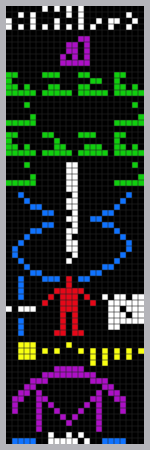
When I think of Arecibo, I remember reading in my astronomy textbook (long ago, before Wikipedia) about the bitmap we sent to the star cluster in Hercules (M13). Transmitted in 1974, it’s about .2% of the way to its destination, by my figuring.
Kimra and I traveled to a really good dark sky site only an hour away to see the Perseids this year. We saw some good meteors, and I took the opportunity to get a better picture of our neighbor M31.
Missed this gem in the morning last week, but it was shining through the haze after sunset tonight. Hopefully it will clear up some in the coming days. Not a great picture compared to the billions that can be found on the internet, but it’s mine. It’s nice to see another naked eye comet, and it’s great through Kimra’s birding binocs.
Mars passed behind the moon this morning, exiting around 04:30 here in Minden, NV. I didn’t see it enter the lit side as it was below the horizon (and/or earlier than I wanted to wake up). Since the moon and Mars were between the Trifid and Lagoon nebulae I was kind of hoping for to catch those as well. As soon as I saw how much of a crescent moon there was I knew that was out of the question. Clouds too. If you know where to look you can see the core of the Lagoon in the below photo as dim fuzziness near the top center, but all of my attempts to bring it out just wash out the photo with moonlit haze. This is a few minutes after Mars appeared when the clouds had cleared more:
Here’s the quick pic I posted this morning, a few minutes earlier and right after final contact:
Both are 400mm f/6, the top is about 8 sec and the bottom shorter.
It was an early morning to catch the rising sun here in the west with Mercury already close to mid-transit. My goal was to catch it with the Pine Nut Mountains silhouetted in the foreground. I set up the scope inside the night before with the plan to shoot out of a window, but when I woke up this morning I realized that my neighbor’s tree was in the way. Luckily I woke up before my alarm and had time to move the scope outside (not a trivial task). One mistake: I forgot to check the ISO, which was set at 12k for focusing on stars the night before. A little sensitive for solar photography ha ha…but it came out OK. Mercury is the little dot near center.
Here’s the setup just before sunrise, looking toward Mt. Siegel and the Galena Saddle. You can see that the sun chose to rise in the flight path for SF Bay Area traffic:
Here’s a somewhat crisper view (after bringing the ISO down to 100). I just missed the jet that left the contrail:
Last Saturday it was almost midnight when I changed my mind about photographing 46P/Wirtanen. I had talked myself out of it, but Saturday the 16th was the closest approach of this comet that was getting a lot of press (“Green Christmas Comet”) considering how dim it was. Also the skies here were pretty clear, and by midnight the moon had set below the Sierra. Barely visible unaided, near the Pleiades, it looked rather nice through binocs (though unspectacular). The moon was going to get worse in the coming nights, so it was now or never.
I made the decision to go for it, taking some shortcuts with the setup and setting a goal to be done within two hours. It went fine.
Later, when I pulled the ten 1.5 minute exposures off the camera, I was surprised how much the comet moved over the course of 15 minutes. Of course comets move, but so do a lot of things in space; just not many move noticeably in such a short span. This repeat visitor was indeed close to us.
It’s kind of neat to see how quickly it cooks along. Here is a GIF of the 10 frames and 15 minutes of motion:
Now to stack the images rather than animate them. The software I use to combine multiple exposures is called Deep Sky Stacker, and it has some interesting comet options. In the first example, here’s how much the stars moved in relation to the comet as a fixed point:
If you stack the 10 exposures and fix to the comet, you get the above star trails. If you fix to the stars, you get one very blurry comet:
Finally, deep Sky Stacker does have an option called “Star Freeze,” allowing the 10 stacked images to keep both the stars and the comet fixed:
Clearly some extra image processing voodoo going on here, but I like it anyway. It also makes me realize that if I were to go to the trouble of tracking a comet with the mount, I’d be stuck with star trails and it would be a challenge to get a similar picture. The 1.5 minute exposures would yield a crisper comet if tracked, but hey, they’re fuzzy anyway, right? Lots of trade-offs when you’re trying to shoot comets, I guess.
I acquired a Canon T4i for the eclipse and afterward did a full spectrum mod on it, which is slightly different than what I did with my old (and sold) Canon 1000d. We also moved to Nevada, so it’s a bit darker here. Here’s a 1:30s f/2.2, ISO 800 100mm unfiltered test shot of the new camera compared to the old one which used a filter to mitigate the sky glow.
Been pretty busy with work so instead of the elegantly crafted composite that I described in a previous post, I thought I’d just ask Photoshop to jam a bunch of exposures together. It’s quite a bit chunky in places, stylized, and still overexposed near the moon, but pretty in its own way while giving you an idea of the complexity of the corona. Also I was able to eke out the earthshine. You often see this with a normal moon, when the earth’s light illuminates the dark part of a crescent moon (listen to the Rush song for a good description). In this case, we have earthshine from a new moon. You can see some seas (including Tranquility), and some craters (including Tycho in the extreme lower right). I didn’t just paste it in–it really came from the exposures during totality. Mars is the small bright spot above the eclipse.
400mm/t4i, composite of a bunch of exposures and tweaked like mad.
This shot captures the end of totality, with the photosphere of the sun shining through a gap in the lunar terrain (Baily’s Beads, or a small carat Diamond Ring). Also visible are a few prominences (flame-like) and the chromosphere (reddish fringe). Because the prominences of this eclipse were in the upper right and the moon was moving down and to the left, the prominences appear at their largest here as the two minutes of totality come to a close.
End of Totality. 400mm f/6 AT66/Canon T4i, 1/4000 sec.
I’ll do a series of longer posts at some point, but I wanted to dash off a quick one with a picture to compare with the corona shape prediction in the last post. It was a beautiful sight, made more so by sharing with family and good friends. I shot with 4 cameras (one was just a point and shoot, shooting video of the scene). The below is from a Canon T3i, 100mm, f/4, 1.3 sec, ISO 100. Also visible are Mercury (very bottom), Regulus (bright at left), and Mars (top right quadrant).
The prediction was pretty good. They streamer they missed coming straight up was nice surprise I wasn’t expecting. But knowing the orientation of the poles was _very_ helpful for aligning the 400mm scope. I look forward to the hours I’ll spend playing with these shots.



 Scott's Sky Shots